Gomining is hosted Bitcoin Hashrate With Data Center Dependence
Gomining is a hosted Bitcoin-mining platform where a digital miner, an NFT representing computing power, earns BTC without equipment at home. Each miner links stated hashrate and energy efficiency to physical data-center operations, while electricity, service charges, network difficulty, and operator continuity determine the value received.
It is a Bitcoin mining platform for users who want hashrate without owning rigs, using NFT miners while charging electricity and service fees.
Choosing Hosted Hashrate Over a Home ASIC
The supporting detail is gathered in Gomining all about limits checklist. Hosted hashrate through Gomining fits when avoiding ASIC ownership matters more than controlling the machines, electricity contract, repair schedule, and pool account behind Bitcoin mining. That trade buys convenience, not infrastructure independence.
Owning a Bitmain Antminer S21 gives physical control, but also transfers noise, heat, circuit capacity, firmware, and repair work to the owner. NiceHash sells access to a marketplace for computing power, so the buyer purchases hashrate for an order rather than a continuing NFT position. Bitdeer Cloud Hash Rate uses contracted plans tied to specified hashrate and term conditions. A direct BTC purchase through Coinbase creates price exposure without mining revenue or maintenance deductions. Gomining occupies the middle ground: it packages hosted output in a transferable digital asset, while the operating company still supplies every machine and data-center service.
Choose the model whose control boundary matches the work and counterparty dependence you accept.
Maintenance Costs Before Gross BTC Rewards
Net BTC remains attractive only when pool revenue exceeds electricity and service deductions, so Gomining costs must be evaluated per TH/s and per W/TH before purchase.
Electricity converts the miner's W/TH and TH/s into watts, multiplies by 24 hours, and divides by 1 000 to reach daily kilowatt-hours.
The maintenance discount has several separate layers. Paying with GOMINING tokens uses 20 published coverage bands: 0-17 days earns 0%, 18-35 days earns 1%, and each additional 18-day band adds 1 percentage point until 360 days reaches 20%. The Service button adds 0.3% per UTC day and reaches 3% after 10 consecutive days; missing one day resets that progress. VIP status supplies another banded discount, while Mining Mode receives a governance-funded component. Token balances, farm power, and the exchange rate move the amount needed to maintain a tier, even though the coverage thresholds themselves stay fixed.
The economics change when Bitcoin difficulty, BTC price, pool output, or the platform's posted service rate moves.
Six Fixed Parameters and Their Failure Boundaries
Six fixed operating parameters expose where a Gomining position stops behaving as expected, from unit conversion and power ceilings to settlement timing and marketplace reservations, which is discussed in Gomining about rewards fundamentals.
| Parameter | Fixed Value | Main Failure Mode |
|---|---|---|
| Hashrate unit | 1 TH/s = 1 000 000 000 000 H/s | Mismatched units distort power comparisons |
| Power ladder | 20 levels; 1 to 5 000 TH/s | Upgrades stop at the platform ceiling |
| Mining Mode accounting | 1 complete UTC day | A mid-day switch omits a daily credit period |
| Service button | Once per UTC day; 0.3% daily; 3% after 10 days | One missed UTC day resets progress |
| In-app token locks | Maximum 30 simultaneous locks | A 31st lock cannot be created |
| Marketplace reservation | 1 hour | An unpaid reservation is cancelled at expiry |
These limits answer operational questions, but they do not forecast return. A miner at the 5 000 TH/s ceiling still earns from the same pool formula and pays costs proportional to its power. One complete UTC day controls Mining Mode accounting, while the 1-hour marketplace clock controls only an unpaid purchase reservation. The 30-lock cap applies to veGOMINING positions held inside the platform wallet, not external Ethereum wallets. Treat each parameter as a boundary on a different workflow; combining them into one yield assumption confuses account rules with Bitcoin mining economics.
Buying the First Miner and Establishing Control
A first purchase should begin with the miner's TH/s, W/TH, payment route, and receiving wallet, because those four choices determine cost, net output, and transferability.
Creating a miner lets the buyer choose hashrate and efficiency, then receive it in the platform wallet or a compatible external wallet. The marketplace becomes available after at least 1 miner exists; secondary offers accept GOMINING and reserve a purchase for 1 hour. Collections operate on Ethereum, BNB Smart Chain, Solana, and TON, with the exact chain fixed by collection. MetaMask and Trust Wallet display compatible assets, while OpenSea supports public NFT resale for supported collections. Network selection matters because an NFT issued on one chain does not move to an unrelated address format.
KYC Level 1 unlocks miner minting, selling, and token withdrawals; BTC withdrawal also requires a primary miner created through the platform.
In-app purchases processed by Apple, Google, or Ecommpay can remain under review for up to 90 days, during which minting and marketplace listing stay unavailable. The transfer route changes after verification completes.
BTC Rewards, Reinvestment, and Two Mining Modes
Mining Mode suits predictable daily accounting, while Miner Wars replaces individual pool attribution with weekly competition, so the preferred mode turns on payout cadence and variability.
Mining Mode credits BTC once per day after a complete 00:00-to-00:00 UTC period, with maintenance deducted before the virtual-wallet balance appears.
Reinvestment can route earned BTC into extra TH/s on one selected miner or into GOMINING tokens. TH reinvestment accepts miners from 10 to 5 000 TH, requires efficiency better than 20 W/TH, and needs at least $0.10 in daily earnings; listed miners, installment miners, and miners with an active power subscription are excluded. Token reinvestment carries a fixed 2.25% fee. TH reinvestment adds no separate fee, although the upgrade uses the available price when the operation settles.
Miner Wars closes on Tuesday-to-Tuesday 7-day cycles. Joining a Clan ends Mining Mode for that UTC day; leaving resumes daily credit only after 1 full UTC day back in Mining Mode. The choice changes when steady daily pool allocation matters more or less than competitive weekly outcomes.
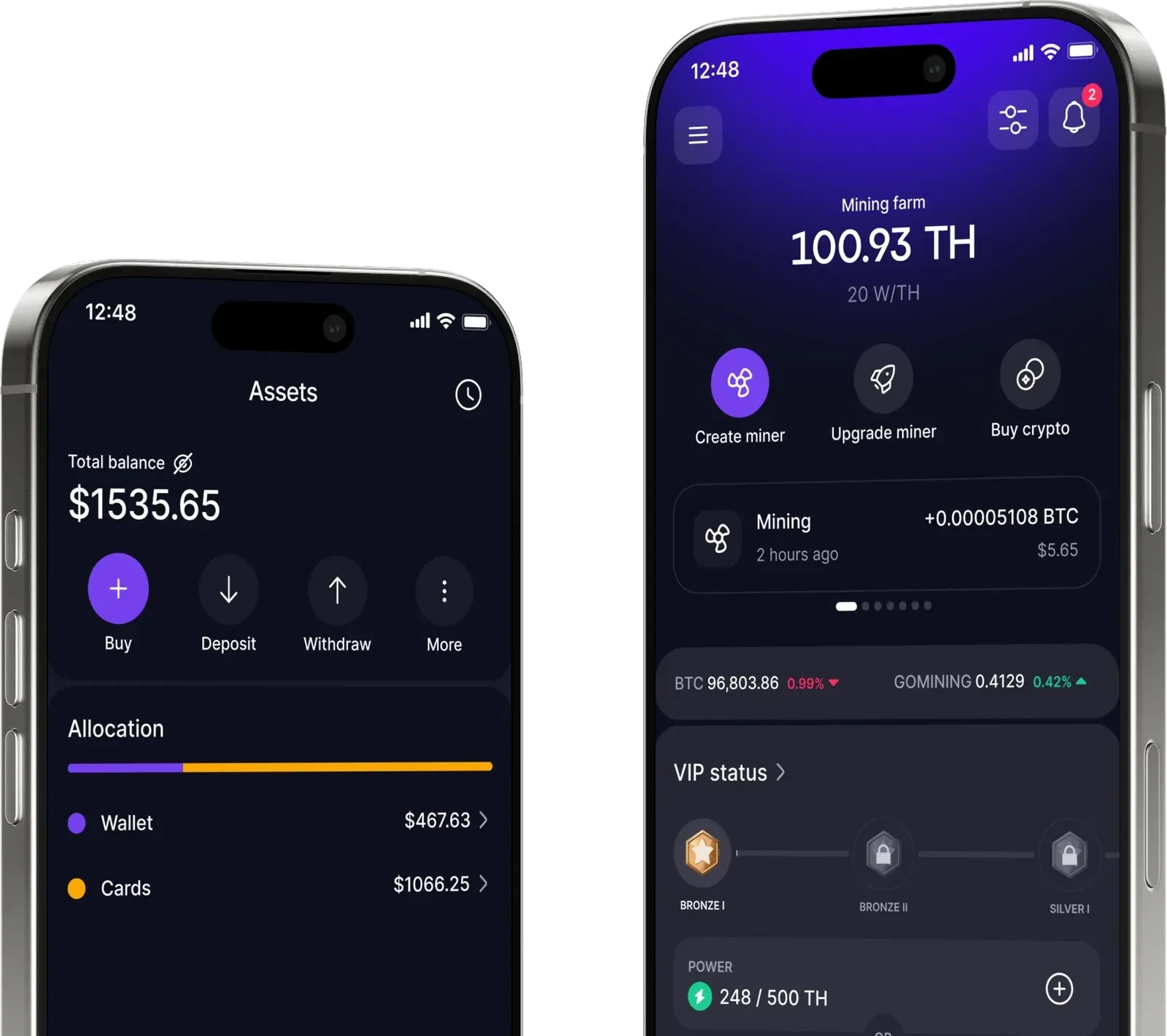
What Does the Digital Miner NFT Actually Represent?
The digital miner represents a stated share of physical Bitcoin hashrate only while Gomining operates the matching data-center capacity and attributes pool output to that asset.
One terahash per second equals 1 000 000 000 000 hash attempts per second. The NFT records TH/s and W/TH as economic attributes; it is not an ASIC and does not contain a Bitcoin private key.
Bitcoin mining uses ASIC hardware to hash block headers under proof of work. A pool aggregates participating hashrate, submits shares, and allocates BTC output under its payout method. Gomining uses these data-center and pool layers beneath the NFT interface. The holder sees a digital position, while physical maintenance, firmware, power delivery, cooling, and pool credentials remain with the operator.
Tokenization adds transfer and marketplace functions on Ethereum, BNB Smart Chain, Solana, or TON. ERC-20 and BEP-20 describe fungible GOMINING token routes, not the Bitcoin mining process itself. The mechanism changes if the operator stops maintaining the mapped fleet or stops attributing its output.
Custody, Marketplace Liquidity, and Operator Dependence
Operator continuity is the decisive risk because NFT ownership and marketplace transfer do not keep physical miners powered, repaired, pooled, or credited when data-center service stops.
A lower W/TH reduces the electricity deduction but does not freeze mining economics. Bitcoin difficulty adjusts every 2 016 blocks, so the same TH/s earns a smaller share when total network work rises. BTC price also changes how dollar-denominated maintenance converts into BTC. Those movements can push a marginal miner to zero net reward under reward protection, which prevents a negative daily balance but does not create positive output.
Liquidity presents a separate constraint. OpenSea or the internal marketplace requires a willing buyer, and a listed miner cannot receive TH reinvestment. Moving the NFT to MetaMask or Trust Wallet proves address control; it does not transfer the data center, electricity agreement, or operating obligations.
Account rules add another boundary: KYC Level 1 gates minting and selling, and some payment routes impose a 90-day review period. Exposure changes when transfer eligibility and buyer demand improve.
Does Gomining Replace Direct Bitcoin Ownership?
Direct Bitcoin ownership remains the cleaner choice when the goal is BTC price exposure, whereas Gomining fits users specifically seeking mining output without running an ASIC.
Buying BTC through Coinbase moves the asset into a wallet and removes mining difficulty, power efficiency, and service charges from the return calculation. A Bitmain Antminer S21 grants physical mining control but demands suitable power, ventilation, noise tolerance, pool setup, and maintenance. NiceHash provides an order-based hashrate market. Bitdeer Cloud Hash Rate uses time-bound service plans. Each alternative puts custody, operational control, and provider reliance in a different place.
The Gomining route is most coherent when the buyer values transferable tokenized hashrate, accepts platform custody and KYC for key actions, and understands W/TH before increasing TH/s. Treat BTC rewards as operating output after costs, not as a fixed yield on the NFT purchase price.
Choose direct BTC when simplicity is paramount, home hardware when physical control matters, and hosted hashrate when outsourced operations justify the added dependency. A related page handles this in practice.
Helpful answers about Gomining
Does the NFT artwork change Bitcoin mining rewards?
No, NFT artwork does not change the published Bitcoin mining reward calculation. Computing power and energy efficiency determine the economic result, while visual rarity traits do not enter the BTC reward formula. TH/s controls the miner's share of pool output, and W/TH controls its electricity burden. Artwork can affect marketplace appeal, but any resale premium is separate from Bitcoin credited through mining.
Can a secondary-market miner unlock BTC withdrawals by itself?
No, a secondary-market miner alone does not unlock BTC withdrawals. The account must pass KYC verification and create at least one primary miner directly through Gomining before BTC can leave the virtual wallet. A transferred or imported NFT can operate within the account, but it does not satisfy the primary-purchase condition on its own.
How long can a veGOMINING lock run?
A veGOMINING lock runs from 1 week to 4 years. Longer terms create more initial voting power, and votes decline each week until the lock ends. An Ethereum wallet supports one active lock, while the platform wallet supports up to 30. Tokens committed to the lock remain unavailable for ordinary use until the chosen term expires.
Are digital miners available on every supported blockchain?
No, each digital-miner collection is issued on a specific supported chain. The published set includes Ethereum, BNB Smart Chain, Solana, and TON, but one NFT does not exist on all four simultaneously. The receiving address must support the collection's chain, and marketplace or wallet compatibility must be checked for that particular asset before transfer.
What happens if an in-app purchase is still being verified?
An in-app purchase under review remains restricted from external transfer and resale. Purchases processed through Apple, Google, or Ecommpay can carry a verification period of up to 90 days, during which the miner cannot be minted to an external wallet or listed for sale. Mining access and transfer access should therefore be treated as separate states until verification finishes.
Do tax reports come with a Gomining account?
No, Gomining does not calculate personal tax obligations or supply jurisdiction-specific tax advice. Account records and transaction histories provide raw activity data, but classification of mining income, token transactions, disposals, and fees follows local rules. Keep records of BTC credits, maintenance deductions, NFT purchases, transfers, and sales in the units and dates required by the relevant filing system.